This Is Why I’m “Difficult”

I’ve been thinking about this a lot. And by a lot I mean the kind of thinking that creeps up on you when you step back from the noise and suddenly everything feels a little absurd. Like, bro, are we not tired of pretending this is fine?
There is a specific pressure placed on women in creative industries that rarely gets named honestly. Not just to monetize your work, but to monetize your body, your personality, your trauma, your politics, your youth, and eventually your decay. This pressure is sold to us as freedom. Be visible. Be sexy. Be empowered. Be authentic. But also be respectable. Be tasteful. Don’t be cringe. Don’t be desperate. Don’t age. Don’t gain weight. Don’t complain.
If you feel confused, good. That confusion is the system working exactly as designed.
I’ve lived most of my adult life in creative spaces. Music, art, fashion, performance. Spaces that claim to reject capitalism while functioning as some of its most efficient laboratories. You are encouraged to be sexual to get attention, then punished for not being taken seriously. If you refuse that route, there’s another option: make yourself smaller, rougher, uglier. Call it rebellion. Call it anti-beauty. Call it authenticity. Either way, your body is still the site of negotiation.
This isn’t accidental. Feminist economists and media theorists have written for decades about how neoliberal systems absorb critique and repackage it as identity. Sexual liberation becomes branding. Resistance becomes an aesthetic. Algorithms reward extremes because extremes drive engagement. Multiple studies in media psychology and platform economics show the same thing: outrage, sexualized imagery, and polarizing personas outperform nuance every single time. Not because they’re better, but because they’re easier to consume.
For women, this intersects with objectification in ways that are deeply physical. Psychological research has consistently linked chronic self objectification to anxiety, depression, body shame, disordered eating, and dissociation. When your survival or success is tied to how you are perceived, your nervous system never shuts up. You are always performing a risk assessment. Am I desirable enough? Am I too much? Am I aging wrong? Am I wasting my potential by not selling myself harder?
And yes, before anyone jumps in, I know. Choice exists. Pleasure exists. Feeling yourself can be fun. Liberation is real. But pretending these choices happen in a vacuum is intellectual dishonesty. When one path is consistently rewarded with money, visibility, and safety, and the other is punished with invisibility, the word choice starts to feel a little thin.
Take Julia Fox. Celebrated endlessly as a feminist icon, applauded for her boldness, her performance, her refusal. And yet, materially, she has spoken openly about financial instability in one of the most expensive cities in the world. The applause is loud. The support is symbolic. Cultural capital without economic security is not empowerment. It’s spectacle. Sociologists have a name for this: recognition without redistribution. Looks progressive. Changes nothing.
Or look at pop more broadly. Sabrina Carpenter sells the perfect American image, hyper curated, hyper consumable. Her voice softened, her edges sanded down, even though she’s clearly articulate and sharp. Taylor Swift built an empire by staying within the narrow lane of acceptable femininity. Sexy but not threatening. Leg, not body. As she ages, the tone shifts. Suddenly she’s annoying. Calculated. Too much. Jennifer Lopez, on the other hand, has been locked into sex appeal for decades, so now at any age she must perform it or be declared irrelevant.
Meanwhile, men age into gravitas. Wrinkles become wisdom. Desire becomes depth. Older men are still sexy, still brilliant, still allowed complexity. Women get a countdown clock.
There’s also the other side of this mess, the anti sexualization camp that somehow ends up just as controlling. Where women are encouraged to uglify themselves to be taken seriously. Gain weight. Destroy desirability. Perform disinterest. Lola Young being institutionalized after being pushed, exhausted, numbed out by an industry that did not care if she was okay as long as she was producing is not an outlier. It’s a warning. There is a razor thin line between acceptable and unacceptable womanhood, and artists are constantly bleeding on it.
I am autistic. I’ve always struggled with boxes, with scripts, with unspoken rules you’re apparently supposed to follow to earn belonging. Big performative communities exhaust me. Not because community is bad, but because what we often call community is just synchronized branding. Same looks. Same language. Same enemies. Same talking points. On the left and on the right, honestly. Different aesthetics, same rigidity.
My actual community is small and diverse. Different politics, different genders, different beliefs, different ways of living. It works precisely because it’s not about agreement or image. It’s about listening, boundaries, care, and letting people be complicated. That kind of community doesn’t scale well. It doesn’t trend. And yes, maybe that’s privilege. The ability to opt out, to choose slowness, to choose sanity over reach. I’m aware of that.
But here’s the part that really gets me.
There is a narrative that floats around creative industries like it’s some kind of sacred truth: if you don’t want it badly enough, you won’t make it. And what “wanting it” actually means, in practice, is a willingness to endure constant mental, emotional, and often physical harm. Burnout is reframed as dedication. Exploitation becomes a rite of passage. Suffering is aestheticized and sold back to us as proof of authenticity.
I’m not saying art is easy. It isn’t. Creation requires discipline, vulnerability, repetition, and discomfort. But there is a difference between effort and abuse, and the industry depends on blurring that line. Studies on creative labor and precarious work show that when instability is normalized, people internalize harm as personal failure rather than structural violence. If you break, it’s because you weren’t strong enough. If you stop, it’s because you didn’t want it enough.
This myth is especially brutal for women. Pain becomes part of the brand. You’re supposed to be exhausted, anxious, broke, overexposed, underprotected, and grateful for the opportunity. If you set boundaries, you’re labeled difficult. If you slow down, you’re unserious. If you prioritize your body or your mind, you’re told you’re not a real artist.
I’ve learned that I am often perceived as difficult. Not because I am cruel or unprofessional, but because of the combination of how I speak and how I look. I question things. I don’t soften everything I say. I don’t perform constant agreeableness. And visually, I don’t always fit neatly into the role people expect me to play. That combination short-circuits the script. It makes people uncomfortable. So the label appears.
Once you’re marked as difficult, everything you do is filtered through that assumption. Your boundaries become attitude. Your intelligence becomes arrogance. Your refusal becomes ingratitude. And suddenly the narrative flips again: if you’re not succeeding, it must be your personality. Not the system. Not the conditions. You.
When artists with power choose ignorance, choose to kiss ass, choose not to question the machine because it benefits them, it doesn’t just affect them. It normalizes harm for everyone below them. Ignorance might be bliss at the top, but it’s a slap in the face to everyone else navigating the same system without protection.
I will never stand for women being forced to oversexualize themselves to survive. I will also never pretend the women who do are the problem. The culprit is older than all of us. Centuries of patriarchy, economic extraction, and social conditioning that we keep reenacting because it’s profitable and familiar.
What I’m tired of is the lying. The pretending this is healthy. The pretending everyone is fine. The pretending exhaustion is ambition and numbness is freedom. Study after study in mental health, especially among young women, shows rising anxiety, depression, burnout, and identity fragmentation. But sure, clap louder. Maybe the algorithm will hear you.
I stepped away. From the spotlight. From the endless selling. From being told I should want more visibility, more content, more optimization. And yes, it was isolating at first. Sociologists call this norm enforcement. Leaving a dominant system always feels lonely before it feels clear.
Now I write. I read. I paint. I make music without trying to turn myself into a product. And no, that doesn’t make me less ambitious or less talented or less deserving. It just means I refuse to confuse self destruction with success.
If any of this makes you uncomfortable, that’s okay. Discomfort is information. I’m not asking anyone to agree. I’m asking us to be honest. Because at some point we have to admit it. The system isn’t broken. It’s working. And it’s making a lot of people miserable.
I don’t want to be optimized. I want to be human. And honestly, that feels radical enough.
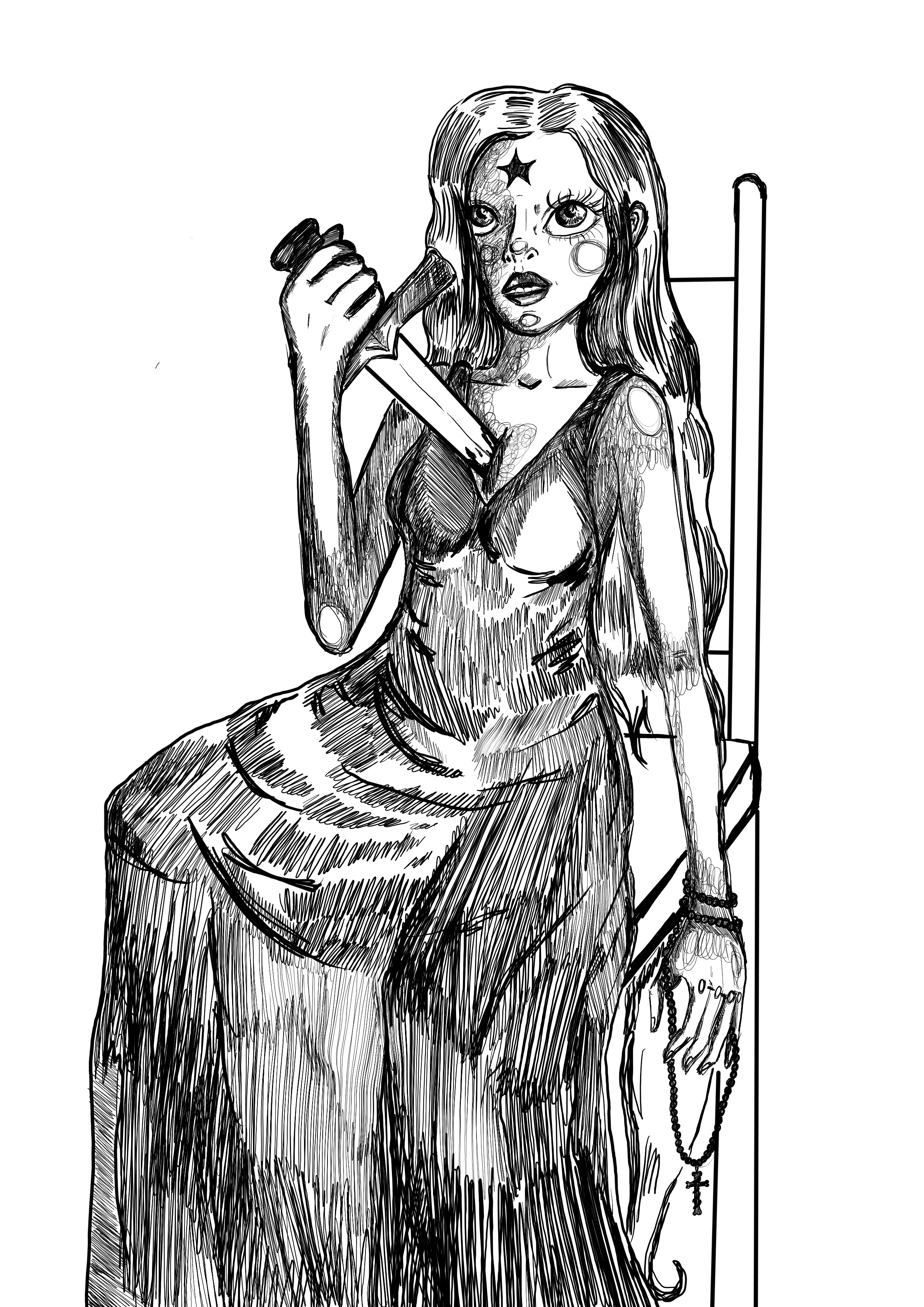
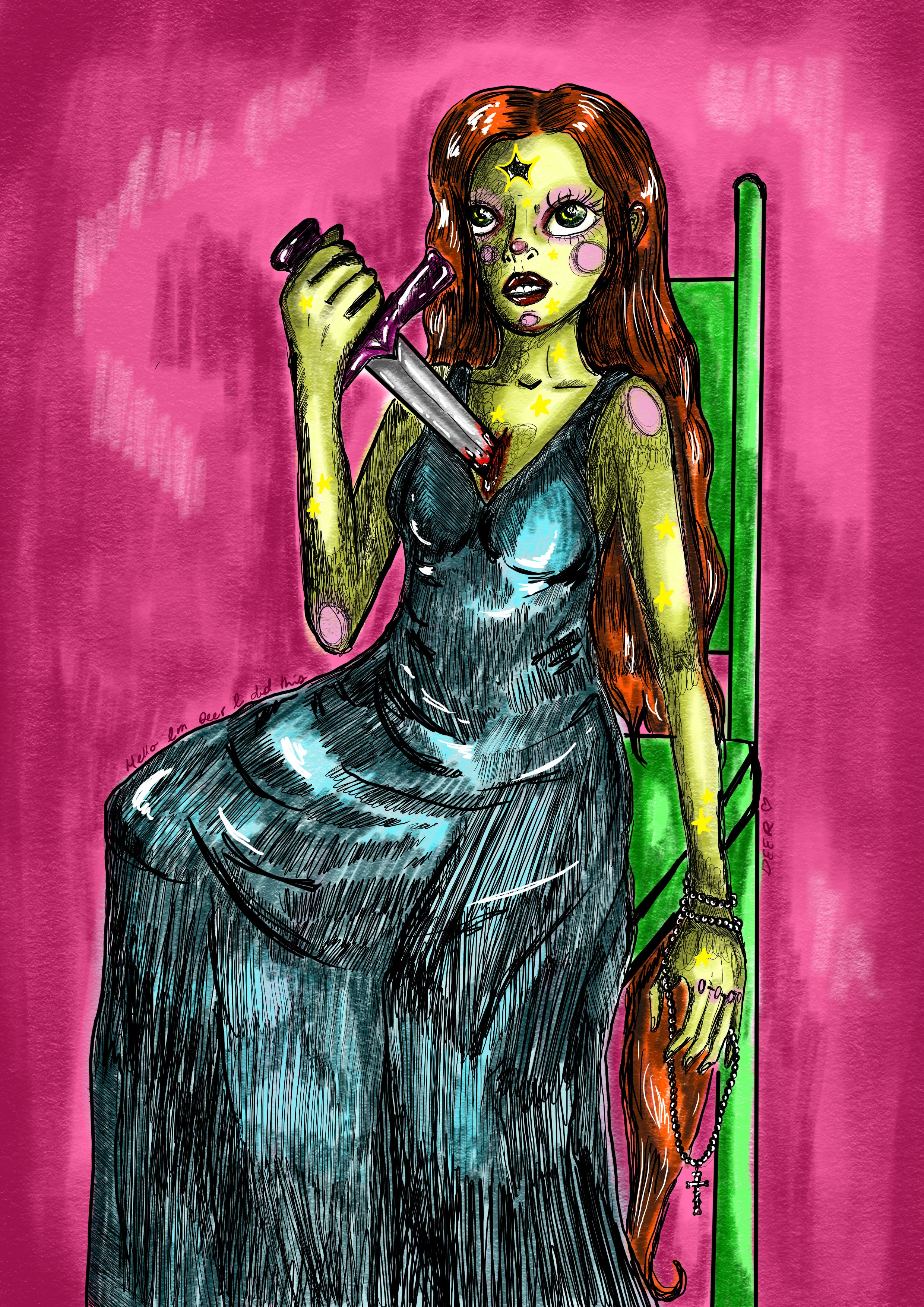
Ps: This illustration lives in the same aftermath as the essay. It is not about violence as spectacle, but about awareness after harm. The figure is marked, seated, and conscious—past the moment of impact, resisting erasure and myth.
The blade and the rosary coexist without resolution, reflecting how systems aestheticize damage while offering faith, beauty, or narrative in place of care. Harm is remembered rather than dramatized, held rather than performed.
Like the essay itself, the work suggests that awareness is not passive. It is what remains when denial collapses and spectacle loses its power.